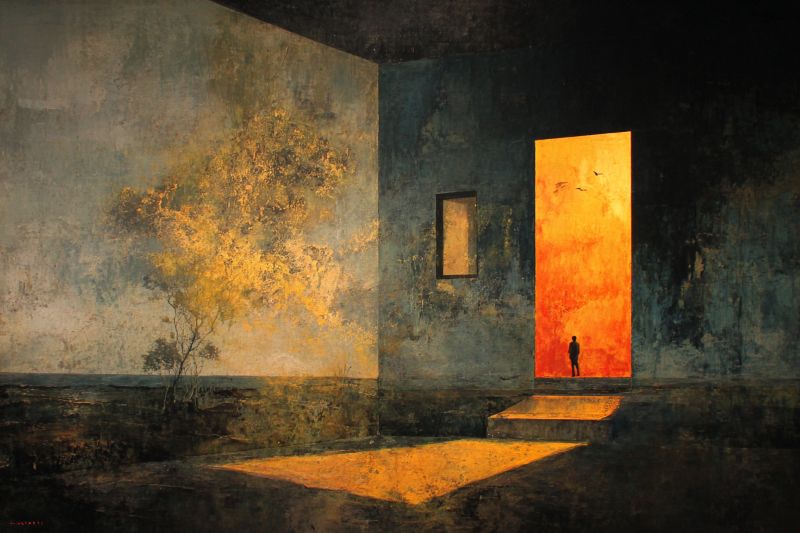
We achieved more than any generation before us. We optimized, accelerated, and produced at unprecedented scale. And then, at the summit, we looked around and felt nothing. These thinkers examine what happens when a life is full of accomplishments and empty of significance.
I
“The world is bursting with wonder, and yet it’s the rare productivity guru who seems to have considered the possibility that the ultimate point of all our frenetic doing might be to experience more of that wonder.”
Oliver Burkeman · Four Thousand Weeks, 2021
Burkeman asks the question the entire productivity industry refuses to answer. Efficient for what? Fast toward where? If the engine is running perfectly but no one on board can say where the destination is, then efficiency is not a virtue. It is a distraction from the absence of one.
II
“Bullshit jobs regularly induce feelings of hopelessness, depression, and self-loathing. They are forms of spiritual violence directed at the essence of what it means to be a human being.”
David Graeber · Bullshit Jobs, 2018
Graeber does not use the word “spiritual” loosely. The violence he names is not physical. It is the slow destruction of a person’s sense that their existence matters. A job that produces nothing meaningful does not merely waste time. It hollows out the person performing it.
III
“The society of laboring and achievement is not a free society. It generates new constraints.”
Byung-Chul Han · The Burnout Society, 2015
Han exposes the freedom myth. Achievement society promises liberation: you can be anything, do anything, become anything. But the freedom to endlessly produce is not freedom. It is a new form of captivity, and the warden is your own ambition.
IV
“Productivity is a trap. Becoming more efficient just makes you more rushed, and trying to clear the decks simply makes them fill up again faster.”
Oliver Burkeman · Four Thousand Weeks, 2021
The treadmill is invisible because it looks like progress. You finish the list. The list grows. You optimize the process. The process expands. Burkeman’s insight is that productivity does not create margin. It eliminates it, and calls the elimination an improvement.
V
“It is as if someone were out there making up pointless jobs just for the sake of keeping us all working.”
David Graeber · Bullshit Jobs, 2018
Graeber describes a system that creates work for its own sake, not because the work needs doing, but because a population busy working does not ask dangerous questions. The most dangerous question of all: why are we doing this?
VI
“Your experience of being alive consists of nothing other than the sum of everything to which you pay attention.”
Oliver Burkeman · Four Thousand Weeks, 2021
Burkeman reduces life to its simplest terms. Not your resume. Not your legacy. Not your net worth. Your attention. If your attention is consumed by tasks that do not matter to you, then your life, in the most literal sense, is being spent on things that do not matter.
VII
“Our very idea of productivity is premised on the idea of producing something new, whereas we do not tend to see maintenance and care as productive in the same way.”
Jenny Odell · How to Do Nothing, 2019
Odell identifies the bias that strips meaning from daily life. Raising a child is not productive. Maintaining a friendship is not productive. Cooking a meal, tending a garden, sitting with a dying parent: none of these count. The things that matter most are invisible to the systems that measure worth.
VIII
“Yet for some reason, we as a society have collectively decided it’s better to have millions of human beings spending years of their lives pretending to type into spreadsheets than freeing them to knit sweaters, play with their dogs, start a garage band, or sit in cafes arguing about politics.”
David Graeber · Bullshit Jobs, 2018
Graeber makes the absurdity visible by listing what we could be doing instead. The list is not frivolous. It is a catalogue of things that actually sustain human life: creativity, companionship, play, and conversation. The system does not value these because they cannot be optimized.
IX
“Hyperactivity, hysterical work, and production are reactions to a life that has become bare and radically fleeting.”
Byung-Chul Han · The Burnout Society, 2015
Han reverses the common diagnosis. We do not work frantically because we are ambitious. We work frantically because we are afraid. The activity fills a void that stillness would expose. Stop moving and you might have to ask what all the movement was for.
X
“The real measure of any time management technique is whether or not it helps you neglect the right things.”
Oliver Burkeman · Four Thousand Weeks, 2021
Burkeman reframes the entire field. The question is not how to do more. It is what to deliberately leave undone. Meaning is not found by adding. It is found by subtracting: removing the inessential until what remains is the thing that actually matters.
XI
“Spending all day in a sterile office environment, I’m too mentally numb to do anything but consume meaningless media.”
David Graeber · Bullshit Jobs, 2018
Graeber quotes a worker who identifies the cycle exactly. Meaningless work produces numbness. Numbness drives meaningless consumption. Meaningless consumption enables another day of meaningless work. The circuit is closed. There is no exit built into the design.
XII
“In an age of instrumentalization, the hobbyist is a subversive: he insists that some things are worth doing for themselves alone, despite offering no payoffs in terms of productivity or profit.”
Oliver Burkeman · Four Thousand Weeks, 2021
The hobbyist is dangerous because they refuse the transaction. They do something for no reason other than the doing of it. In a world where every activity must justify itself in terms of output, pleasure without purpose is a quiet form of resistance.
XIII
“I’ve also learned that patterns of attention, what we choose to notice and what we do not, are how we render reality for ourselves.”
Jenny Odell · How to Do Nothing, 2019
Meaning is not found. It is rendered. What you attend to becomes real. What you ignore ceases to exist. If you attend only to metrics, deadlines, and performance reviews, then that is the reality you have built. A different attention would build a different world.
XIV
“If sleep represents the high point of bodily relaxation, deep boredom is the peak of mental relaxation.”
Byung-Chul Han · The Burnout Society, 2015
Han rehabilitates boredom. It is not a failure of stimulation. It is a form of mental rest that the overstimulated mind can no longer reach. Without deep boredom, the mind never rests deeply enough to ask the questions that only arise in stillness.
XV
“The moral and spiritual damage that comes from performing meaningless work is profound. It is a scar across our collective soul.”
David Graeber · Bullshit Jobs, 2018
Graeber insists on the word “soul.” Not productivity. Not efficiency. Soul. The damage is not economic. It is existential. A society that organizes itself around meaningless labor is not merely wasteful. It is committing a form of collective self-harm.
XVI
“Once you no longer need to convince yourself that the world isn’t filled with uncertainty and tragedy, you’re free to focus on doing what you can to help.”
Oliver Burkeman · Four Thousand Weeks, 2021
Burkeman locates meaning not in success but in surrender. Stop pretending you can control everything. Stop trying to optimize the uncontrollable. What remains, once the illusion drops, is the small, real work of helping: modest, imperfect, and finally meaningful.
XVII
“A refusal to believe that the present time and place, and the people who are here with us, are somehow not enough.”
Jenny Odell · How to Do Nothing, 2019
Odell defines meaning by what it does not require. It does not require travel, achievement, novelty, or escape. It requires only the willingness to believe that this moment, this place, and these people are sufficient. The refusal is radical because the entire economy depends on your dissatisfaction.
XVIII
“How are workers supposed to find meaning and purpose in jobs where they are effectively being turned into robots?”
David Graeber · Bullshit Jobs, 2018
Graeber’s question has no comfortable answer. You cannot find meaning in a process that treats you as a function. Meaning requires agency, creativity, and the sense that what you do changes something. Remove those and what remains is not work. It is endurance.
XIX
“We tend to place a lot of emphasis on our circumstances, assuming that what happens to us determines how we feel. Our brains instead construct our worldview based on what we pay attention to.”
Cal Newport · Deep Work, 2016
Newport’s insight applies directly to meaning. A meaningful life is not one in which good things happen. It is one in which attention is directed toward things that matter. You can have an objectively successful life and feel empty, because your attention was never on the right things.
XX
“Let your impossible standards crash to the ground. Then pick a few meaningful tasks from the rubble and get started on them today.”
Oliver Burkeman · Four Thousand Weeks, 2021
Burkeman ends where meaning begins: in the wreckage of perfectionism. The meaningful life does not start after everything is in order. It starts in the mess. It starts when you stop waiting for conditions to be ideal and do the small, imperfect thing that actually matters to you.
Voices from the Past
The hunger for meaning is not modern. What is modern is the particular way we have learned to ignore it, filling the void with productivity, consumption, and the relentless belief that the next achievement will be the one that finally satisfies.
“He who has a why to live can bear almost any how.”
Viktor Frankl · Man’s Search for Meaning, 1946
Frankl wrote this after surviving Auschwitz. The insight is not motivational. It is clinical. Those who survived the camps were not necessarily the strongest or the luckiest. They were the ones who had a reason to survive. Meaning is not a luxury. It is a survival mechanism.
“One must imagine Sisyphus happy.”
Albert Camus · The Myth of Sisyphus, 1942
Camus does not say Sisyphus is happy. He says we must imagine him so. The distinction matters. In a universe without inherent purpose, meaning is not discovered. It is chosen. The rock will roll back down. You push it anyway. And in the pushing, something human persists.
“Ivan Ilyich’s life had been most simple and most ordinary and therefore most terrible.”
Leo Tolstoy · The Death of Ivan Ilyich, 1886
Tolstoy names the quiet horror: a life lived entirely according to convention, meeting every expectation, offending no one, and arriving at death with the sudden realization that none of it was real. The ordinary life, unlived and unexamined, is Tolstoy’s definition of hell.
“It is not death that a man should fear, but he should fear never beginning to live.”
Marcus Aurelius · Meditations, c. 170 AD
Marcus Aurelius was an emperor with unlimited power and finite time. His fear was not losing his throne. It was losing his life to distraction, obligation, and the failure to be present. The fear he names is the same one that wakes people at 3 a.m. in their comfortable beds: the suspicion that they have not yet begun.
“Vanity of vanities, all is vanity. What does man gain by all the toil at which he toils under the sun?”
Ecclesiastes · c. 3rd century BC
The oldest burnout literature ever written. Ecclesiastes is not nihilism. It is honesty. The question is not rhetorical. It demands an answer. And the answer, if you sit with the question long enough, is not nothing. It is: only what you did with love.
About the Thinkers
Albert Camus (1913-1960) was a French-Algerian philosopher, author, and journalist. His essay The Myth of Sisyphus confronts the absurdity of existence and argues that meaning must be created, not found. He received the Nobel Prize in Literature in 1957.
Byung-Chul Han is a South Korean-born, Berlin-based philosopher whose work examines how modern societies produce exhaustion and the evacuation of meaning through the relentless pursuit of achievement. His books include The Burnout Society and The Scent of Time.
Cal Newport is an American computer science professor and author whose book Deep Work argues that sustained focus is both increasingly rare and increasingly necessary for producing work that matters.
David Graeber (1961-2020) was an American anthropologist and activist. His book Bullshit Jobs: A Theory argued that a significant portion of modern employment is meaningless and that the psychological damage of performing pointless work constitutes a form of spiritual violence.
Jenny Odell is an American artist, writer, and educator at Stanford University. Her book How to Do Nothing reframes attention as the raw material of meaning and argues that maintenance, care, and presence are the activities most consistently erased from our definition of productivity.
Leo Tolstoy (1828-1910) was a Russian novelist and moral philosopher. His novella The Death of Ivan Ilyich remains one of the most devastating portraits of a life lived without examination and the terror that accompanies its recognition.
Marcus Aurelius (121-180 AD) was a Roman emperor and Stoic philosopher. His Meditations, written as private notes to himself, are a sustained practice in attention, discipline, and the refusal to waste the brief time one is given.
Oliver Burkeman is a British author and journalist whose book Four Thousand Weeks challenges productivity culture by confronting the radical finitude of human life and arguing that meaning is found not through efficiency but through deliberate limitation.
Viktor Frankl (1905-1997) was an Austrian neurologist, psychiatrist, and Holocaust survivor. His book Man’s Search for Meaning, based on his experience in Nazi concentration camps, argues that the primary human drive is not pleasure but the pursuit of meaning.
Sources
Albert Camus, The Myth of Sisyphus (Gallimard, 1942). Translated by Justin O’Brien.
Byung-Chul Han, The Burnout Society (Stanford University Press, 2015). Translated by Erik Butler.
Cal Newport, Deep Work: Rules for Focused Success in a Distracted World (Grand Central Publishing, 2016).
David Graeber, Bullshit Jobs: A Theory (Simon & Schuster, 2018).
Ecclesiastes, Hebrew Bible, c. 3rd century BC.
Jenny Odell, How to Do Nothing: Resisting the Attention Economy (Melville House, 2019).
Leo Tolstoy, The Death of Ivan Ilyich, 1886.
Marcus Aurelius, Meditations, c. 170 AD.
Oliver Burkeman, Four Thousand Weeks: Time Management for Mortals (Farrar, Straus and Giroux, 2021).
Viktor Frankl, Man’s Search for Meaning (Beacon Press, 1946).
Curated by Nishant Mishra / The Nervous Age · Words for a world that won’t sit still.


Leave a comment