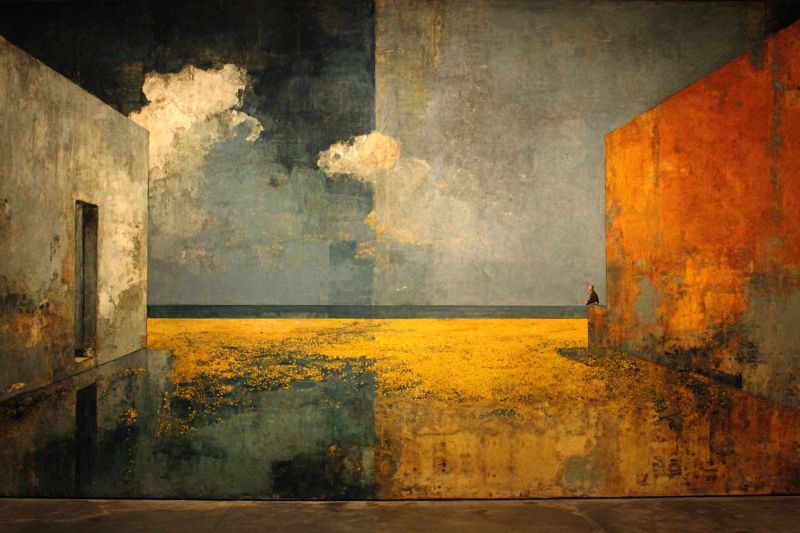
There is a particular kind of silence that settles over a life governed by money it does not have enough of. It is not the silence of peace. It is the silence of calculation: the mental arithmetic that runs beneath every conversation, every meal, every decision about whether to see a doctor or wait another month. The person doing this math does not look distressed. They look normal. They go to work. They pay what they can. They absorb the difference between what life costs and what they earn as a private failure, even though the gap was never personal.
Money is the subject everyone thinks about and almost no one speaks about honestly. Not the aspirational money of investment advice and entrepreneurial mythology. The other kind. The rent money. The debt money. The choosing-between-two-necessities money. The kind that determines not just what you can buy but what you are allowed to imagine for yourself. The thinkers gathered here have looked at this silence and refused to leave it unnamed. They write about poverty not as a character flaw but as a condition produced by systems, and about wealth not as a reward but as a question that most economies would rather not answer.
I.
“Debt is the most effective way to take a relation of violent subordination and make the victim feel that it is they who are in the wrong.”
David Graeber · Debt: The First 5,000 Years, 2011
Graeber overturned the polite fiction that debt is a neutral financial instrument. It is a moral technology. The person in debt does not simply owe money. They owe obedience, gratitude, silence. The shame that accompanies owing is not accidental. It is structural. It keeps the debtor compliant and the creditor unquestioned.
II.
“What you don’t necessarily realize when you start selling your time by the hour is that what you’re actually selling is your life.”
Barbara Ehrenreich · Nickel and Dimed, 2001
Ehrenreich spent months working minimum-wage jobs and returned with a report that read less like journalism and more like an autopsy of the American dream. The exchange she describes is the one nobody frames honestly: you are not selling labor. You are selling hours of your finite existence. And the market has decided those hours are worth less than the cost of living through them.
III.
“Poverty is not simply the condition of not having enough money. It is the condition of having your life administered by the priorities of others.”
Matthew Desmond · Poverty, by America, 2023
Desmond moves past the familiar narrative of scarcity and into the architecture of control. To be poor is to have your time, your choices, your geography, and your dignity managed by landlords, employers, bureaucracies, and systems that benefit from your compliance. The poverty is financial. The consequence is the loss of self-determination.
IV.
“When the rate of return on capital exceeds the rate of economic growth, the past devours the future.”
Thomas Piketty · Capital in the Twenty-First Century, 2013
Piketty’s formula is elegant and devastating. Inherited wealth grows faster than earned wealth. The economy rewards those who already have more than those who work. The future, for most people, is not a place of expanding possibility. It is a place where the advantages of the past compound while wages stagnate. The silence between paychecks is the sound of this equation at work.
V.
“Poverty is not a lack of character. It is a lack of cash.”
Rutger Bregman · Utopia for Realists, 2017
Bregman’s line is deliberately blunt because the myth it opposes is deeply embedded. The belief that poverty reflects moral failure is not just wrong. It is useful, useful to systems that would rather blame individuals than redesign structures. The simplicity of his statement is its strength: the problem is not the person. The problem is the missing money.
VI.
“Scarcity captures the mind. When you are preoccupied with not having enough, you have less cognitive capacity for everything else.”
Sendhil Mullainathan · Scarcity, 2013
Mullainathan and his co-author Eldar Shafir demonstrated something that the poor already knew: financial stress does not stay in the financial department of the brain. It leaks into everything. Decision-making. Parenting. Health. The bandwidth tax of poverty means that the person with the least margin for error is operating with the least mental capacity to avoid it.
VII.
“I cleaned houses and hotel rooms and worked as a server to survive. I was not lazy. I was not broken. I was doing everything the system asked and still could not afford to live.”
Stephanie Land · Maid, 2019
Land’s memoir is a record of effort that the economy refused to reward. She worked multiple jobs, applied for every available program, did everything the culture tells poor people to do, and remained poor. The book is not a complaint. It is evidence. Evidence that the relationship between hard work and economic security is, for millions of people, a fiction.
VIII.
“The marketplace does not reward the work of caring. It rewards the work of accumulating.”
Tressie McMillan Cottom · Thick, 2019
Cottom identifies a valuation problem at the center of the economy. The work that holds society together, caregiving, teaching, nursing, feeding, cleaning, is systematically underpaid. The work that extracts value, trading, managing, optimizing, is systematically overpaid. The silence between paychecks is loudest among people doing the work that everyone needs and nobody wants to fund.
IX.
“Algorithms now determine who gets a loan, who gets hired, and who gets surveilled. And these models disproportionately punish the poor.”
Cathy O’Neil · Weapons of Math Destruction, 2016
O’Neil maps the intersection of money and technology. The systems that sort and score human beings are trained on historical data that already encodes inequality. The algorithm does not create poverty. It automates it. The poor are not just financially disadvantaged. They are computationally disadvantaged, processed by systems that treat their zip code as a verdict.
X.
“The burnout we feel is not just emotional. It is economic. We are exhausted because the cost of existing has outpaced the means of existing.”
Anne Helen Petersen · Can’t Even, 2020
Petersen connects the emotional and the financial in a way that most burnout literature avoids. The exhaustion is not purely psychological. It is the lived experience of running harder and falling further behind. The millennial burnout she describes is not a mood. It is a budget crisis dressed as a lifestyle problem.
XI.
“The great risk shift has moved economic insecurity from the government and corporations onto the shoulders of ordinary families.”
Jacob Hacker · The Great Risk Shift, 2006
Hacker documents a transfer so gradual that most people experienced it as personal bad luck rather than policy. Pensions became 401(k)s. Stable employment became contract work. Health coverage became a negotiation. The risks that institutions once absorbed were quietly handed to individuals, who now carry them as anxiety, debt, and sleepless nights.
XII.
“The precariat is not simply a class defined by insecurity of income. It is a class defined by the loss of a narrative: no career, no predictable future, no stable identity.”
Guy Standing · The Precariat, 2011
Standing gives a name to a condition that affects millions who do not think of themselves as a class. The gig worker, the adjunct professor, the freelancer, the zero-hours contractor: they share not just financial instability but a narrative instability. They cannot answer the question of where they will be in five years, and the inability to answer erodes something deeper than savings.
XIII.
“The families I met were not struggling because they had made poor choices. They were struggling because every choice available to them was poor.”
Alissa Quart · Squeezed, 2018
Quart spent years interviewing middle-class families caught between rising costs and stagnant wages. The book dismantles the myth of bad decisions. The parents she profiles budgeted carefully, worked multiple jobs, delayed every pleasure, and still could not close the gap. The choices were not the problem. The options were.
XIV.
“We are told to love what we do. But that commandment has become a tool for making people accept less pay, less security, and less respect.”
Sarah Jaffe · Work Won’t Love You Back, 2021
Jaffe identifies a weaponized emotion. The instruction to find passion in work has been repurposed as a justification for underpayment. If you love what you do, the logic goes, compensation is secondary. The love becomes the salary. And the worker who objects is framed not as underpaid but as ungrateful.
XV.
“The winners of our economy have found it easier to give back than to not take so much in the first place.”
Anand Giridharadas · Winners Take All, 2018
Giridharadas examines philanthropy as a system of control. The generosity of the wealthy is real, but it operates within rules the wealthy themselves designed. The giving does not challenge the structure that produced the inequality. It manages it. The silence between paychecks continues while the gala celebrates its own compassion.
XVI.
“The person who exploits himself carries the entire operation within himself: exploiter and exploited in one.”
Byung-Chul Han · Psychopolitics, 2014
Han extends his concept of self-exploitation into the economic sphere. The freelancer who works through illness, the entrepreneur who sleeps four hours, the gig worker who rates their own exhaustion as commitment: each has internalized the market’s demands so completely that external coercion is no longer necessary. The silence between paychecks is the silence of a person who has become their own employer and their own cost to cut.
XVII.
“Saving capitalism means saving it from itself: from the forces within it that concentrate wealth and power to the point where the system no longer serves most of the people within it.”
Robert Reich · Saving Capitalism, 2015
Reich argues from within. He is not calling for the end of markets but for their reform, which may be more radical than it sounds. The problem is not capitalism as a concept. It is capitalism as it currently operates: a system that generates wealth brilliantly and distributes it catastrophically. The gap between the two is the space where most people live.
XVIII.
“Our relationship with money is a mirror. It reflects what we value, what we fear, and what we believe we deserve.”
Lynne Twist · The Soul of Money, 2003
Twist moves the conversation inward without letting the system off the hook. Money is structural, yes, but it is also emotional. The scarcity mindset, the shame of not having, the guilt of having more than others: these are not just financial facts. They are feelings that shape decisions, relationships, and the stories people tell themselves about their own worth.
XIX.
“The wealth hoarders do not simply have more than others. They have arranged the rules so that having more becomes self-perpetuating.”
Chuck Collins · The Wealth Hoarders, 2021
Collins, himself an heir who gave away his inheritance, examines the infrastructure of extreme wealth: the trusts, the offshore accounts, the tax strategies, the lobbying networks that ensure the concentration of money is not a market outcome but a designed one. The silence between paychecks on one end is the compound interest on the other.
XX.
“The cruelty of modern poverty is not that it kills. It is that it exhausts. It takes everything and leaves just enough for the person to show up tomorrow and do it again.”
Matthew Desmond · Evicted, 2016
Desmond returns to close the circle with the observation that makes his work so difficult to set aside. Poverty in a wealthy nation is not primarily about deprivation. It is about depletion. The person survives. That is the point. They survive just enough to remain functional, to continue producing, to keep the silence between paychecks from becoming a sound that anyone else has to hear.
Voices from the Past
The anxiety of not having enough did not begin with rent increases and gig economies. It runs through centuries of human reflection on wealth, labor, simplicity, and the question of what a person actually needs. These five voices, writing long before anyone calculated a cost-of-living index, understood that money is never just money. It is a measure of what a society values and who it is willing to sacrifice.
XXI.
“It is not the man who has too little who is poor, but the one who hankers after more.”
Seneca · Letters to Lucilius, c. 65 AD
Seneca was a wealthy man writing about poverty, which makes this line either wisdom or hypocrisy, depending on your generosity. But the observation endures because it identifies something real: the experience of scarcity is not purely material. It is relational. It is the distance between what you have and what you have been taught to want. That distance, in the modern economy, is engineered to grow.
XXII.
“The cost of a thing is the amount of what I will call life which is required to be exchanged for it, immediately or in the long run.”
Henry David Thoreau · Walden, 1854
Thoreau measured expense not in dollars but in hours of life surrendered. His economy was radical in its simplicity: if a thing costs you a week of labor, you are not buying the thing. You are spending a week of your life. The calculation has not changed. What has changed is the cost, which now consumes not weeks but decades.
XXIII.
“The art of being wealthy is not in the accumulation of possessions but in the fewness of wants.”
Aristotle · Politics, c. 350 BC
Aristotle distinguished between natural wealth, which sustains life, and artificial wealth, which has no limit. The modern economy is built almost entirely on the second kind. The wants are manufactured, multiplied, and refreshed quarterly. The person who has enough but wants more is, by Aristotle’s measure, poorer than the person who has little and wants less.
XXIV.
“Beware of little expenses. A small leak will sink a great ship.”
Benjamin Franklin · Poor Richard’s Almanack, 1758
Franklin’s proverb was practical advice for colonial Americans. It has aged into something harsher. In an economy where the small expenses, a medical co-pay, a transit fare increase, a grocery price adjustment, are no longer small at all, the leaks are not negligence. They are structural. The ship is not sinking from carelessness. It was built with holes.
XXV.
“Annual income twenty pounds, annual expenditure nineteen and six, result happiness. Annual income twenty pounds, annual expenditure twenty pounds ought and six, result misery.”
Charles Dickens · David Copperfield, 1850
Dickens understood the arithmetic of survival with novelistic precision. The margin between sufficiency and catastrophe is not wide. It is sixpence. It is the difference between a paycheck that covers the month and one that falls short by a fraction. The silence between paychecks is the sound of that margin thinning.
About the Thinkers
Alissa Quart (b. 1972) is an American journalist and executive director of the Economic Hardship Reporting Project. Squeezed documents how rising costs and stagnant wages have eroded the financial stability of middle-class American families.
Anand Giridharadas (b. 1981) is an Indian-American journalist and author. Winners Take All examines how elite philanthropy and thought leadership serve to preserve the systems that produce inequality.
Anne Helen Petersen (b. 1981) is an American journalist and author. Can’t Even examines millennial burnout as a structural condition rooted in economic precarity, student debt, and the erosion of stable employment.
Aristotle (384-322 BC) was a Greek philosopher whose works on politics, ethics, and economics remain foundational to Western thought. His distinction between natural and unlimited wealth continues to resonate.
Barbara Ehrenreich (1941-2022) was an American journalist and author. Nickel and Dimed, her undercover investigation of low-wage work in America, became a landmark of participatory journalism and economic criticism.
Benjamin Franklin (1706-1790) was an American polymath, statesman, and writer. Poor Richard’s Almanack, published annually for twenty-five years, offered practical wisdom on thrift, labor, and self-reliance.
Byung-Chul Han (b. 1959) is a Korean-born, German-based philosopher. Psychopolitics examines how neoliberal systems exploit the psyche, turning individuals into self-optimizing subjects who internalize economic demands as personal motivation.
Cathy O’Neil (b. 1972) is an American mathematician and data scientist. Weapons of Math Destruction examines how algorithmic decision-making systems reinforce inequality, particularly in lending, hiring, and criminal justice.
Charles Dickens (1812-1870) was an English novelist whose works, including David Copperfield and Bleak House, portrayed poverty, debt, and class with detailed compassion and social urgency.
Chuck Collins (b. 1959) is an American author, activist, and heir who gave away his inheritance at twenty-six. The Wealth Hoarders investigates the professional infrastructure that enables extreme wealth concentration.
David Graeber (1961-2020) was an American anthropologist and activist. Debt: The First 5,000 Years reframes the history of money and obligation, and Bullshit Jobs examines the proliferation of meaningless work.
Guy Standing (b. 1948) is a British economist and professor. The Precariat identifies and analyzes a growing global class defined by chronic economic insecurity, lack of occupational identity, and political disengagement.
Henry David Thoreau (1817-1862) was an American essayist, naturalist, and philosopher. Walden, his account of simple living, offers a radical critique of an economy that trades life for possessions.
Jacob Hacker (b. 1971) is an American political scientist at Yale University. The Great Risk Shift documents how economic risks have been transferred from institutions to individuals over the past several decades.
Lynne Twist (b. 1945) is an American author, fundraiser, and global activist. The Soul of Money examines the emotional and spiritual dimensions of humanity’s relationship with money, scarcity, and sufficiency.
Matthew Desmond (b. 1980) is an American sociologist at Princeton University. Evicted and Poverty, by America examine how housing instability and systemic exploitation sustain poverty in one of the world’s wealthiest nations.
Robert Reich (b. 1946) is an American economist, professor, and former Secretary of Labor. Saving Capitalism argues that the rules governing markets have been tilted to benefit the wealthy at the expense of working people.
Rutger Bregman (b. 1988) is a Dutch historian and journalist. Utopia for Realists advocates for universal basic income and shorter working hours, arguing that poverty is a policy choice, not an inevitability.
Sarah Jaffe (b. 1984) is an American journalist and author. Work Won’t Love You Back examines how the ideology of loving your work has been used to justify low pay, poor conditions, and the erosion of labor protections.
Sendhil Mullainathan (b. 1973) is an Indian-American economist and professor at the University of Chicago. Scarcity, co-authored with Eldar Shafir, examines how the psychology of not having enough affects cognition and decision-making.
Seneca (c. 4 BC-65 AD) was a Roman Stoic philosopher, statesman, and dramatist. His Letters to Lucilius address wealth, contentment, and the discipline of wanting less in a world that rewards accumulation.
Stephanie Land (b. 1978) is an American author and advocate. Maid, her memoir of working as a house cleaner while raising a daughter in poverty, was adapted into a widely watched Netflix series.
Thomas Piketty (b. 1971) is a French economist. Capital in the Twenty-First Century argues, through extensive historical data, that wealth inequality is a built-in feature of capitalism, not an anomaly.
Tressie McMillan Cottom (b. 1980) is an American sociologist and writer at the University of North Carolina. Thick and Lower Ed examine race, class, and the economics of aspiration in contemporary America.
Curated by Nishant Mishra / The Nervous Age · Words for a world that won’t sit still.



Leave a comment