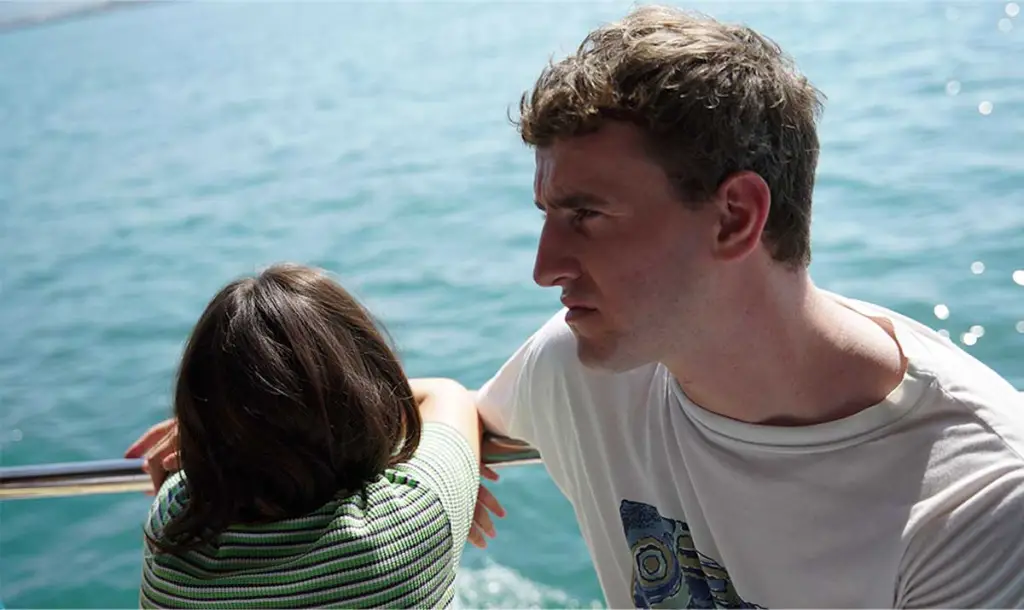
There is a moment in Charlotte Wells’s Aftersun when Sophie, eleven years old and sunburned and happy, points a camcorder at her father in their hotel room. She is recording him the way children record everything: without agenda, without composition, just the camera held up like a window she happens to be standing behind. Calum smiles. He performs ease. And then she turns the camera away, and for a half-second before the scene cuts, something crosses his face that she does not see.
The entire film lives in that half-second.
Aftersun is set in a Turkish resort in the late 1990s. A young father and his daughter on a package holiday. They swim. They play pool. They eat buffet dinners and browse market stalls and have the kind of conversations that happen between a parent and a child who are close but not quite fluent in each other yet. Nothing dramatic happens. The film does not need anything dramatic to happen. What it needs is the gap between what Sophie sees and what Calum is carrying, and it builds that gap with the patience of someone who knows that the audience will feel it before they understand it.
Calum is not well. The film never names it. There is no diagnosis scene, no confession, no breakdown staged for the viewer’s clarity. What there is, instead, is texture. A held breath in a doorway. A long exhale after Sophie falls asleep. A body that moves through the holiday with the careful steadiness of someone who is using every remaining unit of energy to appear fine. Wells does not explain Calum. She films the surface and trusts us to feel the weight beneath it.
This is what makes Aftersun a film about modern life, even though it is set twenty-five years ago. It is a film about what parents hide. About the performance of okayness that adults deliver daily, sometimes for years, to protect the people who love them. Calum is not lying to Sophie. He is giving her the holiday. He is giving her the version of her father that an eleven-year-old can hold without breaking. And the cost of that gift is visible only to us, watching from the distance that Sophie will later spend her adult life trying to close.
Because the film has a second layer. We are not watching the holiday as it happened. We are watching it as Sophie remembers it, years later, now a woman roughly the age her father was then. The camcorder footage, the hotel corridors, the underwater shots, the strobe-lit nightclub sequences that puncture the narrative like a pulse, these are not scenes. They are acts of memory. Sophie is reviewing the evidence. She is looking at her father’s face in the footage the way you look at a photograph of someone after you finally understand what they were going through, and she is searching for the thing she missed.
She will not find it. That is the cruelty and the honesty of the film. Memory does not return what you failed to see the first time. It returns the angles, the lighting, the shape of a shoulder turning away, and asks you to sit with the not-knowing. Aftersun does not resolve. It does not tell you whether Calum survived the thing he was carrying. It tells you that Sophie is still carrying it too, differently, in the way that children inherit what their parents could not say.
Wells, in her debut, does something that most filmmakers never manage: she makes silence legible. The film is full of noise, resort noise, pop music, splashing, television in the background, but the emotional register is silence. Calum’s silence. The silence between what he says to Sophie and what he is thinking. The silence of a man on a balcony at night while his daughter sleeps behind a thin wall. These silences are not empty. They are architectural. They hold the film up.
Paul Mescal’s performance is the kind that becomes more devastating on reflection. In the moment, he is warm, funny, slightly awkward, a young father trying hard and mostly succeeding. It is only afterward, when you replay the scenes in your own memory, that you notice the effort. The way his smile arrives a beat late. The way he holds Sophie a little too long in the pool, as if practicing for an absence. Frankie Corio, eleven years old and in her first role, matches him without appearing to act at all. She is not performing a child. She is being one, with all the obliviousness and sudden perceptiveness that childhood contains.
Aftersun is a film about the distance between loving someone and knowing them. About the years it takes to understand what was happening in a room you were standing in. About the unbearable tenderness of watching someone try to be okay for you. It does not ask you to cry. It asks you something harder: to sit with the knowledge that the people closest to you may have been drowning in plain sight, and that your memories of happiness and their experience of crisis may describe the same afternoon.
If this film moved you, you may also want to sit with Hirokazu Kore-eda’s Still Walking (2008), another film about what families sense but never say, set around a single family gathering heavy with unspoken loss. And with Celine Sciamma’s Petite Maman (2021), a quieter, almost fable-like meditation on the gap between a parent’s childhood and a child’s understanding of it.
Curated by Nishant Mishra / The Nervous Age · Words for a world that won’t sit still.

Leave a comment