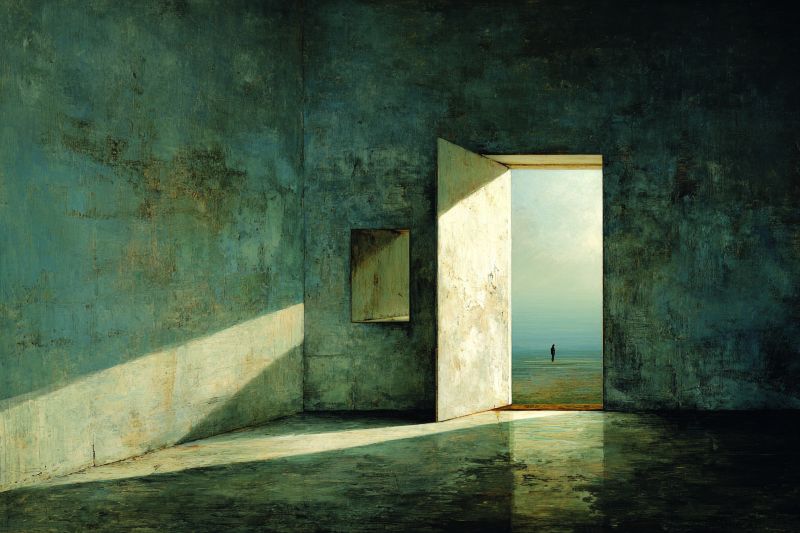
There was a time when privacy was not something you had to argue for. It was the default. You left the house and became anonymous. You bought something and no one recorded it. You thought something and it stayed inside your head. That time is recent. It ended not with a dramatic invasion but with a series of conveniences, each one asking for a small piece of information in exchange for a small improvement in ease, until the accumulation became something no one had consented to as a whole.
Now the room has no curtains. Not because someone broke in and tore them down, but because you were offered a window that let in better light, and a thermostat that adjusted to your preferences, and a mirror that remembered your face, and by the time you noticed, the walls were glass. The surveillance is not hidden. It is comfortable. It is so embedded in the ordinary texture of daily life that objecting to it feels paranoid, eccentric, like complaining about the weather.
The thinkers gathered here do not think the complaint is eccentric. They think the absence of complaint is the problem.
I.
“Surveillance capitalism unilaterally claims human experience as free raw material for translation into behavioral data.”
Shoshana Zuboff · The Age of Surveillance Capitalism, 2019
Zuboff’s sentence should be read slowly, because its weight is in its precision. Human experience. Free raw material. Translation into data. Every word describes an extraction. What you search for, where you walk, how long you pause on an image, these are not neutral traces. They are harvested, processed, and sold. The product is not the app. The product is the pattern of your life.
II.
“Arguing that you don’t care about the right to privacy because you have nothing to hide is no different from saying you don’t care about free speech because you have nothing to say.”
Edward Snowden · Permanent Record, 2019
Snowden dismantles the most common defense of surveillance with a single analogy. The nothing-to-hide argument assumes that rights exist only when you need them personally. But rights are not personal conveniences. They are structural protections. You may not need privacy today. The question is whether you will need it tomorrow, and whether it will still be there.
III.
“Data is not just something about you. It is something that can be used against you, and you may never know when or how.”
Bruce Schneier · Data and Goliath, 2015
Schneier, a security technologist, frames the problem as one of asymmetry. You do not know what data has been collected. You do not know who holds it. You do not know what conclusions have been drawn from it. And you do not know when those conclusions will affect your insurance, your employment, your freedom of movement. The danger is not in the data itself. It is in the invisibility of its use.
IV.
“Humans are now hackable animals. The combination of biological knowledge and computational power makes it possible to manipulate human desires and decisions.”
Yuval Noah Harari · 21 Lessons for the 21st Century, 2018
Harari raises the stakes beyond commerce. The data collected about you is not just used to sell you things. It is used to predict and shape your behavior. The algorithm does not need to know you personally. It needs to know enough about people like you to make your next action statistically likely. The curtain is not just missing. The room is being rearranged while you stand in it.
V.
“Algorithms are opinions embedded in code. And when those opinions operate at scale, on data you never consented to share, they become a form of power without accountability.”
Cathy O’Neil · Weapons of Math Destruction, 2016
O’Neil connects surveillance to governance. The algorithm that decides your credit score, your insurance premium, your eligibility for parole, is not neutral. It carries the assumptions of its designers and the biases of its training data. You are being judged by a system you cannot see, built on information you did not knowingly provide, and there is no appeals process.
VI.
“The NSA’s goal is to collect everything, know everything, and exploit everything. And they are closer to that goal than most people realize.”
Glenn Greenwald · No Place to Hide, 2014
Greenwald reported the Snowden revelations and saw the public reaction oscillate between outrage and resignation. The resignation won. The programs he exposed continued in modified form. The lesson was not that people approve of mass surveillance. It is that the machinery of surveillance has outpaced the machinery of accountability, and the gap grows every year.
VII.
“Privacy is not just the right to be left alone. It is the right to be free: free to think, experiment, change your mind, and become someone new without being tracked.”
Carissa Veliz · Privacy Is Power, 2020
Veliz reframes privacy as the precondition for autonomy. Without it, the self calcifies. If every search, every purchase, every conversation is recorded and profiled, the space for experimentation shrinks. You stop browsing freely. You stop asking questions that might look strange. You stop becoming, because becoming requires the freedom to be unobserved in the process.
VIII.
“We are being re-engineered not by coercion but by design. The tools we use every day are quietly reshaping what it means to be an autonomous human being.”
Brett Frischmann · Re-Engineering Humanity, 2018
Frischmann, co-writing with Evan Selinger, identifies a transformation so gradual that it barely registers as one. The smart device in your pocket is not a tool in the way a hammer is a tool. It is an environment. It shapes your decisions by presenting options in a particular order, limiting your choices to a curated set, and recording every interaction for future refinement. The re-engineering is not forced. It is default.
IX.
“The user is not the customer. The user is the product. The real customers are the companies that pay to predict and influence user behavior.”
Jaron Lanier · Who Owns the Future?, 2013
Lanier restates the fundamental transaction of the surveillance economy with a clarity that makes it difficult to look away. The service is free because you are not receiving a service. You are providing one. Your attention, your data, your behavioral patterns are the raw material. The free app is the harvesting tool. The curtain was never part of the design.
X.
“The internet has become a tool for social control. Not because governments seized it, but because governments realized they didn’t have to.”
Evgeny Morozov · To Save Everything, Click Here, 2013
Morozov challenges the comfortable narrative that surveillance is a government problem solved by corporate innovation. The opposite is closer to the truth. Corporations built the infrastructure of total observation, and governments discovered they could access it more easily than building their own. The partnership between state and platform is not a conspiracy. It is a convenience.
XI.
“Every time you use a search engine, a map, a social network, you are feeding a system that is building a detailed model of who you are.”
Julia Angwin · Dragnet Nation, 2014
Angwin documented her own attempt to live without being tracked. It was nearly impossible. The systems of surveillance are not optional features layered on top of daily life. They are daily life. The map that guides you to work records where you go. The search engine that answers your questions records what you want to know. The model of you is being built whether or not you agreed to sit for the portrait.
XII.
“The black box society is one in which critical decisions affecting our lives are made by processes hidden from public view and shielded from accountability.”
Frank Pasquale · The Black Box Society, 2015
Pasquale names the opacity. The systems that score, sort, and surveil operate behind proprietary walls. The credit score that determines your mortgage, the search ranking that determines what you read, the risk assessment that determines your insurance: each is a black box. You see the output. You do not see the logic. And you have no mechanism to challenge what you cannot see.
XIII.
“The internet began as a surveillance project. Its transformation into a tool for commerce and communication did not erase that origin. It extended it.”
Yasha Levine · Surveillance Valley, 2018
Levine’s history is uncomfortable because it refuses the founding myth. The internet was not born in a garage or a dorm room. It was born in the Pentagon. Its earliest purpose was military communication and intelligence. The surveillance capacity was not added later. It was the original architecture, repurposed and expanded, now operating at a scale its military designers could not have imagined.
XIV.
“AI systems are built on vast quantities of human data, extracted without meaningful consent, and deployed in ways that concentrate power while distributing risk.”
Kate Crawford · Atlas of AI, 2021
Crawford maps the physical and political infrastructure behind artificial intelligence. The data that trains the models comes from people who did not know they were contributing. The labor that labels the data is performed by workers who are underpaid and invisible. The profits flow upward. The surveillance flows downward. The atlas she draws is a map of extraction.
XV.
“Technologies of surveillance do not affect everyone equally. They reproduce and deepen the inequalities they inherit.”
Ruha Benjamin · Race After Technology, 2019
Benjamin insists on a question that most privacy discourse avoids: surveillance for whom? The communities most watched, most profiled, most policed by algorithmic systems are the same communities that have historically been subjected to the most intense forms of state scrutiny. The new surveillance is not neutral. It carries the old hierarchies into new infrastructure.
XVI.
“Automated systems do not simply process existing data. They create new categories of people: the suspicious, the risky, the undeserving.”
Virginia Eubanks · Automating Inequality, 2018
Eubanks examines what happens when surveillance meets welfare. The systems designed to manage poverty do not merely observe the poor. They classify them. They predict their behavior. They assign them to categories that determine what help they receive and what scrutiny they endure. The automation does not replace human judgment. It replaces it with something less visible and less challengeable.
XVII.
“We have collectively built the greatest surveillance infrastructure in the history of humanity, and we did it because each individual component seemed like a good deal at the time.”
Maciej Ceglowski · public talks, 2015
Ceglowski, a programmer and essayist, identifies the mechanism with painful honesty. No one agreed to total surveillance. Everyone agreed to a loyalty card, a free email service, a navigation app, a voice assistant. The consent was micro. The consequence was macro. The curtain came down one convenience at a time.
XVIII.
“The Indian state does not need a surveillance apparatus imported from outside. It has built its own, and it has built it in the name of progress and efficiency.”
Arundhati Roy · public essays, 2019
Roy writes from within a democracy that has embraced biometric identity systems, internet shutdowns, and data centralization as tools of governance. Her warning is specific and global at once: surveillance does not require authoritarianism. It requires only an administration that has decided efficiency matters more than consent. The room has no curtains in New Delhi as surely as in Silicon Valley.
XIX.
“Surveillance culture is not just about being watched. It is about internalizing the awareness of being watched until it changes how you live.”
David Lyon · The Culture of Surveillance, 2018
Lyon identifies the deeper damage. The problem is not only that your data is being collected. It is that you know it is being collected, and that knowledge alters your behavior. You censor yourself. You perform compliance. You avoid the search, the question, the curiosity that might flag you as unusual. The surveillance does not need to punish. It only needs to be known to exist.
XX.
“The digital panopticon does not need walls. It operates through the voluntary submission of subjects who mistake exposure for freedom.”
Byung-Chul Han · The Transparency Society, 2012
Han closes with the inversion that defines the modern condition. The old surveillance required force. The new surveillance requires only a platform. People submit to observation not because they are coerced but because they are rewarded: with convenience, with connection, with the feeling of being seen. The room has no curtains because the occupant removed them voluntarily, believing that transparency and freedom were the same thing.
Voices from the Past
The unease of being watched did not begin with the camera or the algorithm. It is threaded through centuries of political philosophy, architecture, and moral reasoning. These five voices understood that visibility is not neutral, that the eye of power changes the behavior of the observed, and that the right to be unseen is inseparable from the right to be free.
XXI.
“Big Brother is watching you.”
George Orwell · Nineteen Eighty-Four, 1949
Orwell’s phrase has been quoted so often that its precision has blurred. But the genius of the line is not the watching. It is the you. Surveillance in Orwell’s vision is not general. It is personal. It is directed at you, specifically, and it wants you to know it. The awareness of being watched is the mechanism of control. The screen does not need to punish. It needs only to be on.
XXII.
“He who is subjected to a field of visibility, and who knows it, assumes responsibility for the constraints of power. He becomes the principle of his own subjection.”
Michel Foucault · Discipline and Punish, 1975
Foucault took Bentham’s prison design and turned it into a theory of modern power. The panopticon works not because the guard is always watching but because the prisoner can never be certain the guard is not. The uncertainty produces self-regulation. The surveilled subject polices himself. Foucault saw this operating not just in prisons but in schools, hospitals, and factories. He did not live to see it operating in phones.
XXIII.
“The major effect of the panopticon is to induce in the inmate a state of conscious and permanent visibility that assures the automatic functioning of power.”
Jeremy Bentham · Panopticon Letters, 1787
Bentham designed the panopticon as a model of efficiency: a circular prison in which one guard could observe every cell. He considered it humane. The genius, and the horror, of the design is that it does not require constant observation. It requires only the architecture of possible observation. The prisoner behaves because he might be watched. The might is enough.
XXIV.
“The mass of men lead lives of quiet desperation. What is called resignation is confirmed desperation.”
Henry David Thoreau · Walden, 1854
Thoreau was not writing about surveillance. He was writing about conformity, about lives shaped by external expectation rather than inner conviction. But the observation applies with uncomfortable precision to a world in which the awareness of being observed produces a quiet, permanent adjustment of the self. The desperation is not loud. It is the small, continuous act of performing a version of yourself that will not attract unwanted attention.
XXV.
“Over himself, over his own body and mind, the individual is sovereign.”
John Stuart Mill · On Liberty, 1859
Mill’s declaration was radical in 1859 and remains so. The sovereignty he describes, the right of the individual to govern their own thoughts, actions, and inner life without external intrusion, is precisely what modern surveillance erodes. Not violently. Not even visibly. But steadily, through the accumulation of data points that together constitute a map of the self more detailed than any individual would voluntarily draw.
About the Thinkers
Arundhati Roy (b. 1961) is an Indian novelist and essayist. Her nonfiction, including essays on surveillance, nationalism, and state power in India, combines literary precision with political urgency.
Brett Frischmann (b. 1974) is an American law professor at Villanova University. Re-Engineering Humanity, co-authored with Evan Selinger, examines how digital technologies reshape human autonomy and decision-making by design.
Bruce Schneier (b. 1963) is an American security technologist and author. Data and Goliath examines the vast asymmetry between those who collect data and those whose data is collected.
Byung-Chul Han (b. 1959) is a Korean-born, German-based philosopher. The Transparency Society examines how the demand for total visibility has become a new form of social control, producing conformity rather than freedom.
Carissa Veliz (b. 1986) is a Spanish-British philosopher at the University of Oxford. Privacy Is Power argues that privacy is not a personal preference but a political right essential to autonomy and democracy.
Cathy O’Neil (b. 1972) is an American mathematician and data scientist. Weapons of Math Destruction examines how opaque algorithmic systems reinforce inequality in lending, hiring, policing, and insurance.
David Lyon (b. 1948) is a British-Canadian sociologist at Queen’s University. The Culture of Surveillance examines how surveillance has moved from a state activity to a pervasive cultural condition that individuals participate in voluntarily.
Edward Snowden (b. 1983) is an American former intelligence contractor who in 2013 disclosed classified NSA surveillance programs. Permanent Record, his memoir, recounts his decision and its consequences.
Evgeny Morozov (b. 1984) is a Belarusian-American writer and researcher. To Save Everything, Click Here critiques the ideology of technological solutionism and challenges the assumption that Silicon Valley innovations serve democratic values.
Frank Pasquale (b. 1972) is an American law professor at Cornell University. The Black Box Society examines how opaque algorithms and data practices concentrate power in corporations and government agencies beyond public scrutiny.
George Orwell (1903-1950) was an English novelist and essayist. Nineteen Eighty-Four, his final novel, created the enduring vocabulary of modern surveillance: Big Brother, doublethink, thoughtcrime, the telescreen.
Glenn Greenwald (b. 1967) is an American journalist and author. No Place to Hide documents the NSA surveillance programs revealed by Edward Snowden and examines the infrastructure of mass data collection.
Henry David Thoreau (1817-1862) was an American essayist, naturalist, and philosopher. Walden, his account of deliberate living, critiques conformity and the surrender of inner sovereignty to social expectation.
Jaron Lanier (b. 1960) is an American computer scientist, composer, and author. Who Owns the Future? examines how digital platforms extract value from users without fair compensation, concentrating wealth and information in the hands of a few.
Jeremy Bentham (1748-1832) was an English philosopher and social reformer. His Panopticon Letters proposed a prison design based on total visibility, a concept that became central to theories of modern surveillance and power.
John Stuart Mill (1806-1873) was an English philosopher and political economist. On Liberty remains one of the most influential defenses of individual freedom against the intrusions of state and social authority.
Julia Angwin (b. 1971) is an American investigative journalist. Dragnet Nation documents her attempt to evade digital surveillance and the near-impossibility of living untracked in the modern economy.
Kate Crawford (b. 1976) is an Australian-American researcher and professor. Atlas of AI maps the material infrastructure, labor exploitation, and power concentration behind artificial intelligence systems.
Maciej Ceglowski (b. 1976) is a Polish-American programmer, writer, and activist. His public talks on data collection and surveillance have become influential critiques of the technology industry’s approach to user privacy.
Michel Foucault (1926-1984) was a French philosopher and social theorist. Discipline and Punish examines how modern institutions use observation and normalization as instruments of control, extending Bentham’s panopticon into a theory of power.
Ruha Benjamin (b. 1978) is an American sociologist at Princeton University. Race After Technology examines how digital tools and automated systems reproduce racial inequality under the guise of objectivity.
Shoshana Zuboff (b. 1951) is an American professor emerita at Harvard Business School. The Age of Surveillance Capitalism defines and analyzes the economic logic that turns human experience into predictive data for profit.
Virginia Eubanks (b. 1972) is an American political scientist and author. Automating Inequality examines how automated decision-making systems in housing, welfare, and criminal justice disproportionately harm the poor.
Yasha Levine (b. 1978) is a Russian-American investigative journalist. Surveillance Valley traces the military origins of the internet and argues that surveillance has been its foundational purpose, not a later corruption.
Yuval Noah Harari (b. 1976) is an Israeli historian and author. 21 Lessons for the 21st Century examines how data, algorithms, and biotechnology are reshaping freedom, privacy, and the meaning of being human.
Curated by Nishant Mishra / The Nervous Age · Words for a world that won’t sit still.


Leave a comment