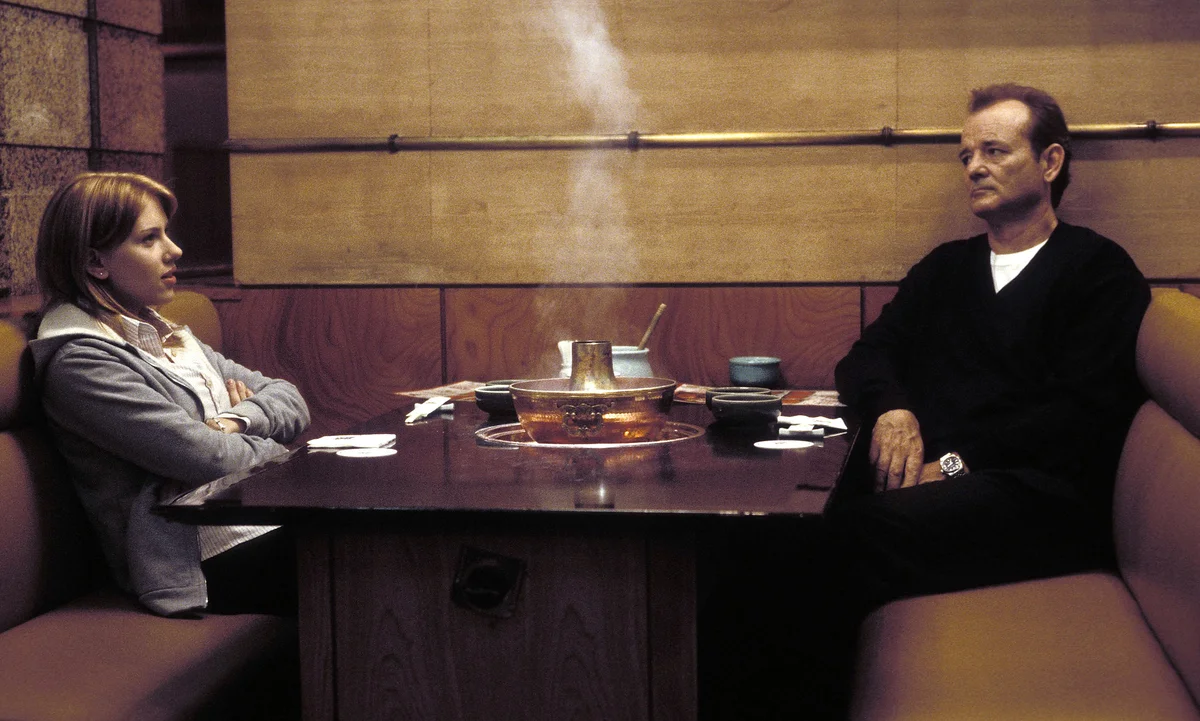
There is a scene near the middle of the film where Bob Harris sits at the edge of his hotel bed at four in the morning, staring at the Tokyo skyline through floor-to-ceiling glass. He is not thinking anything in particular. He is not doing anything. He is just awake in a city where he has no reason to be awake, in a life where he has no reason to be tired, and yet he is both.
If you have ever been in a hotel room in a foreign city at an hour when no one you love is reachable, you know this feeling. It is not sadness, exactly. It is the strange lucidity that comes when the performance of your normal life has been suspended and what remains is just you, without context, without role, without the comfortable noise of routine. It is the feeling of being returned to yourself at an inconvenient time.
Sofia Coppola’s film is often described as a love story, and it is, but the love that unfolds between Bob and Charlotte is almost accidental. They do not find each other because they are searching. They find each other because they are both awake at the same wrong hour, in the same beautiful, incomprehensible city, and neither of them has anywhere else to be. The connection is not romantic in the way movies usually mean romantic. It is the deeper thing: two people recognizing in each other a dislocation they cannot name.
Bob is a fading movie star in Tokyo to shoot a whiskey commercial he is embarrassed by. Charlotte is a young woman who has followed her photographer husband to Japan and discovered, in the long hours alone, that she does not know what her life is for. They are separated by decades, by experience, by everything that would normally prevent two people from understanding each other. And yet they do. Not because they explain themselves well, but because they do not need to.
This is what the film understands about loneliness that most films miss: it is not about being alone. It is about being in the wrong company. Bob has a wife and children. Charlotte has a husband. Neither of them is technically alone. They are surrounded. And they are drowning. The loneliness they share is the specific, modern kind that comes from having everything arranged and still feeling that something essential is missing. Not a person. A frequency. A register of being that no one around them seems to be operating on.
Tokyo in this film is not a backdrop. It is a condition. The city is enormous, luminous, and completely indifferent. Signs flash in a language Bob and Charlotte cannot read. Conversations happen around them that they cannot enter. Karaoke bars pulse with a joy they can observe but not quite reach. The city does not reject them. It simply does not notice them. And there is something both terrifying and freeing about that invisibility. When no one is watching, you do not have to perform. You can be confused. You can be sad without having a reason. You can sit in a bar with a stranger and say almost nothing and feel, for the first time in months, that you are in the right place.
Coppola shoots the film like a long exhale. The pacing is slow in a way that most audiences either love or resist, and the resistance usually comes from people who expect a film to tell them what is happening. This film does not tell you. It shows you. It sits with you in the jet-lagged haze and the neon glow and the 3 a.m. quiet and trusts that you will recognize what you are seeing. If you have been lonely in the way Bob and Charlotte are lonely, no explanation is needed. If you have not, no explanation will be enough.
What moves me most about the film, even after watching it more times than I can count, is how it treats tenderness. Bob and Charlotte are tender with each other in the way that only strangers can be: without history, without expectation, without the accumulated resentments that make long-term intimacy so complicated. They give each other the one thing their real lives have stopped providing: attention. Not productive attention. Not strategic attention. Just the quiet, sustained fact of being noticed by another person who has no obligation to notice you.
There is a moment when Charlotte falls asleep on Bob’s shoulder while they watch a movie in his hotel room. Nothing happens. Nothing needs to happen. The weight of her head against his arm is the entire statement. It says: I trust you enough to stop being awake in your presence. In a film about insomnia and dislocation, sleep is the most intimate act.
And then there is the ending. The whisper. You have seen it or you have not, and if you have, you know that Coppola never reveals what Bob says to Charlotte on that Tokyo street before they part. The audience strains to hear it. The internet has spent two decades trying to decode it. But the whisper is not meant to be understood. It is meant to be felt. Whatever he says, it belongs to them. Not to us. And that privacy, in a culture that insists on disclosure, is its own form of love.
The film does not resolve anything. Bob goes back to his marriage. Charlotte goes back to her uncertainty. The dislocation that brought them together does not heal. What changes is smaller and harder to name: for a few days in a foreign city, two people were fully present to each other, and that presence, however brief, was enough to make the rest of their lives slightly more bearable. Not fixed. Not saved. Just bearable. And sometimes that is all you get, and sometimes that is everything.
If this film sits with you the way it sits with me, you might find yourself reaching for two others.
The first is Her, Spike Jonze’s 2013 film about a man who falls in love with an artificial intelligence. It sounds like science fiction, but it is really about the same loneliness Coppola is mapping: the hunger for a presence that truly attends to you, and the devastation of discovering that even the most perfect attention has limits. Theodore, like Bob, is a man surrounded by a functioning world that does not quite reach him. The difference is that his solution is a voice without a body, a companion designed to understand him. What the film discovers, beautifully and painfully, is that even perfect understanding is not the same as love. Love requires a body that can leave. A voice that might not answer. A presence that is real precisely because it is finite.
The second is In the Mood for Love, Wong Kar-wai’s 2000 masterpiece about two neighbours in 1960s Hong Kong who discover that their spouses are having an affair with each other. They are drawn together by the symmetry of their betrayal, and what follows is one of the most restrained, aching portraits of desire ever filmed. Nothing happens between them, in the physical sense. Everything happens between them, in every other sense. The film is about the space between two people who want each other and will not allow themselves to cross it. Like Lost in Translation, it understands that some connections are most powerful when they remain incomplete. The restraint is not a failure of courage. It is the form the love takes. To consummate it would destroy it. To leave it unfinished is to let it live forever.
All three films share something rare: they trust silence. They trust the audience to feel what is not being said. They do not explain loneliness. They do not offer a cure. They sit inside it, patiently, and let it become something else. Not happiness. Not resolution. Something closer to recognition. The feeling of watching a screen and thinking: yes, that is exactly what it is like. That is exactly how it feels to be awake at the wrong hour, in the wrong city, in a life that looks right from the outside and feels borrowed from the inside.
And that recognition, quiet as it is, is its own form of company.
Nishant Mishra / The Nervous Age · Words for a world that won’t sit still.


Leave a comment