Revenge bedtime procrastination, or the nightly rebellion of staying up past the point of reason
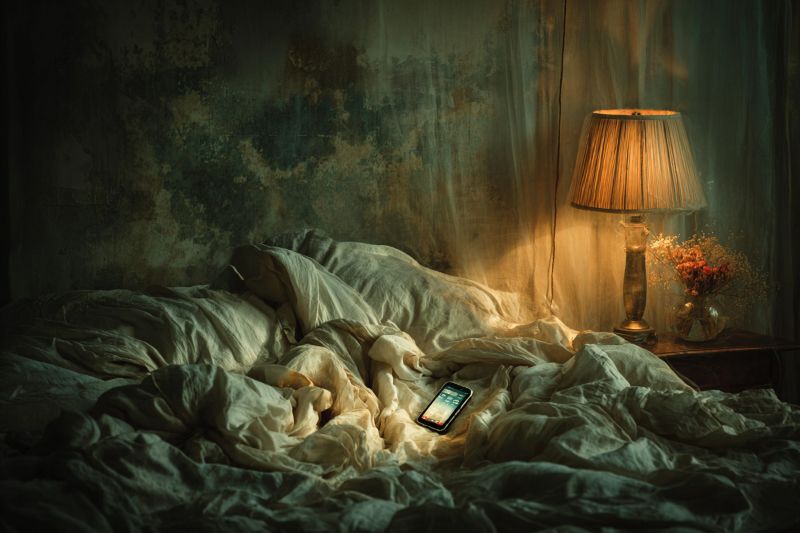
It is 11:47 p.m. You have to wake up at six. You are not doing anything important. You are watching a video you have already half-forgotten, or scrolling through a feed that stopped being interesting twenty minutes ago, or reading the same paragraph of a book for the third time because your eyes are moving but your brain has clocked out. You know you should go to sleep. You know exactly what tomorrow will feel like if you don’t.
You stay up anyway.
Not because you’re not tired. You are tired. You are possibly the most tired you’ve been all day. You stay up because going to sleep means the day is over, and if the day is over, tomorrow starts, and tomorrow already belongs to someone else. The commute, the emails, the meetings, the school run, the meal prep, the obligations that stack themselves into your hours before you’ve had a chance to decide what to do with any of them. Sleep is surrender. Not to rest — to the schedule. And something in you, some stubborn animal part that has been compliant all day, refuses.
This is revenge bedtime procrastination. And if the phrase sounds dramatic — revenge, as if you’re waging war against your own circadian rhythm — that’s because the original term is even more dramatic. It comes from Chinese: 報復性熬夜, which translates roughly as “suffering through the night with vengeance.” It describes people who know that staying up is harming them and do it anyway, because the alternative — surrendering the only hours that feel like theirs — is worse.
The concept first appeared on Weibo, China’s dominant social media platform, around 2018. One of the earliest known posts came from a worker in Guangdong province who wrote, with the plain clarity of someone describing a condition they’ve diagnosed in themselves, that during workdays he “belonged to someone else” and only found himself after getting home. He acknowledged that sacrificing sleep was damaging his health. He did it anyway. He saw no other option.
The context matters. China’s tech industry had normalised what became known as the 996 system: working from 9 a.m. to 9 p.m., six days a week, seventy-two hours in total. A national survey in 2018 found that 60% of Chinese people born after 1990 were not getting enough sleep, with the worst numbers concentrated in the biggest cities — the same cities where 996 was standard practice. State media reported that the average Chinese worker had just 2.42 hours per day that were not consumed by work or sleep, down by 25 minutes from the previous year.
Into that airless schedule, staying up late was not laziness. It was the only act of autonomy available.
The phrase might have stayed on Chinese internet if not for Daphne K. Lee.
Lee, a journalist based in Taiwan, posted a tweet in June 2020 that translated the concept for an English-speaking audience: “A phenomenon in which people who don’t have much control over their daytime life refuse to sleep early in order to regain some sense of freedom during late night hours.” The tweet received over 250,000 likes. Thousands of replies said, essentially, the same thing: I didn’t know there was a word for this.
The timing was not accidental. It was 2020. The pandemic had collapsed the boundaries between work and home, between professional time and personal time, between the hours you owed to someone else and the hours you owed to yourself. For millions of people working from their bedrooms, the commute disappeared but so did the signal that the workday had ended. The office was everywhere, which meant the office was nowhere, which meant freedom was nowhere either — except late at night, after the laptop closed, when the house was finally quiet and the only person making demands on your time was you.
You, of course, made the worst possible demand: stay awake.
Before the word “revenge” entered the picture, sleep researchers had already identified the basic behaviour. A 2014 study from Utrecht University in the Netherlands defined “bedtime procrastination” as the failure to go to bed at the intended time despite no external circumstances preventing it. The researchers flagged three criteria: the delay must reduce your total sleep, there must be no valid external reason for staying up, and you must be aware that your behaviour will produce negative consequences.
That last criterion is the one that stings. This is not insomnia, where you want to sleep and cannot. It is not the natural rhythm of a night owl. It is the deliberate, knowing sacrifice of something you need — rest — for something you want more: the feeling of time that belongs to you. You are not confused about the consequences. You have calculated them and decided that the cost is worth paying. Every night, you make this bargain. Every morning, you regret it. Every night, you make it again.
The Dutch researchers attributed the behaviour primarily to low self-regulation — a failure of willpower, essentially. It was the addition of “revenge,” imported from Chinese internet culture, that reframed the phenomenon entirely. The problem was not weak self-discipline. The problem was a life structured so tightly that the only available rebellion was self-harm.
Anne Helen Petersen, the writer who turned “burnout” into a generational diagnosis, wrote about revenge bedtime procrastination with characteristic precision. The activities people perform during those stolen hours, she noted, are not actually pleasurable. They are the dregs of leisure — half-watched episodes, half-read articles, half-conscious scrolling. The experience is rarely enjoyable in the moment and always costly in the morning. It is, she argued, what happens when the soul refuses to be nourished. Not because it doesn’t want nourishment, but because the only nourishment on offer is unconsciousness, and unconsciousness is not the same as rest.
Sleep is necessary. But sleep is also an act of disappearance. You close your eyes, and when you open them, it is tomorrow, and tomorrow’s obligations are already waiting. The revenge procrastinator is not rejecting sleep. They are rejecting the speed at which today becomes tomorrow. They are pressing their thumb against the fast-forward button and holding it there, even though they know the film will play at the same speed regardless.
There is something uncomfortably honest about the word “revenge.” It implies an enemy. And the enemy, if you follow the logic far enough, is the structure of your own life — the job you need, the responsibilities you chose, the routines that sustain everything and leave nothing over. You are not taking revenge on a boss or a system. You are taking revenge on the day itself. On the way it used you up and left you with nothing but the thin, depleted hours between midnight and the alarm.
Chinese psychologists have described this as a form of compensation in the Freudian sense: a defence mechanism in which people conceal their feelings of inadequacy by indulging in another area. The indulgence, in this case, is time — the illusion of having it, the performance of owning it, even when what you are really doing is borrowing against tomorrow at a punishing interest rate.
A 2019 survey across twelve countries found that 62% of adults globally felt they were not getting enough sleep. Of those, 37% blamed their work or school schedule. The numbers are worse for women, who disproportionately carry the invisible labour of caregiving and domestic management on top of professional work. They are worse for students, who face academic pressure during the day and social pressure at night. They are worse in every demographic that has less control over its waking hours — which is to say, they are worse for almost everyone.
If you recognise yourself in this essay, you already know the advice. Go to bed earlier. Put the phone in another room. Establish a wind-down routine. Protect your sleep the way you protect your calendar.
You also know why the advice doesn’t work — or rather, why it works on the wrong problem. The issue is not that you lack a bedtime routine. The issue is that your life contains insufficient hours that feel like yours, and no amount of sleep hygiene will fix a problem that is, at its root, about autonomy.
The honest answer — the one the productivity articles rarely give you — is that revenge bedtime procrastination is a symptom, not a disease. The disease is a life in which freedom has been compressed into the margins, and the margins happen to fall at midnight. Fixing the symptom means fixing the structure. And fixing the structure means asking a question that is far harder than “how do I fall asleep faster”: what would my days look like if I didn’t need to take revenge on them?
Most people do not have a satisfying answer. But the question is worth staying up for.
See also: Achievement Society · Auto-Exploitation · Deep Work · Doom Scrolling · Grind Culture · Laziness Lie · Productivity Guilt
The Nervous Age · Glossary of Now


Leave a comment