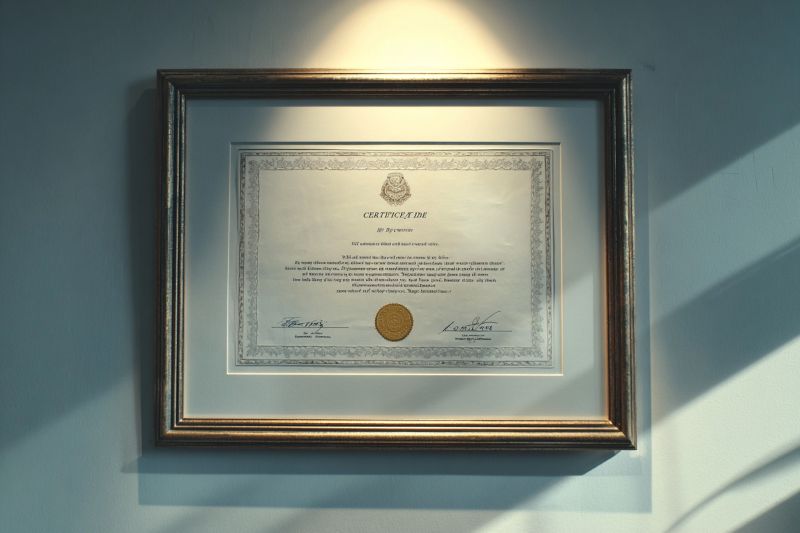
Dear ________,
We are pleased to inform you that you have been selected for ________.
This decision was based on your outstanding ________, your demonstrated expertise in ________, and the unanimous recommendation of the selection committee.
We look forward to welcoming you.
You read the letter twice. Then a third time, slower, as if searching for the retraction hidden somewhere in the second paragraph. You wait for the phone call that will explain the mistake. You rehearse the gracious way you will handle the correction: Of course. I understand. These things happen. You tell a friend, and when they say congratulations, you hear yourself say thank you and immediately begin constructing the case for why you do not deserve it.
The case is airtight. You know things about yourself that the selection committee does not. You know about the paragraph you deleted. The source you did not read carefully enough. The afternoon you spent staring out of the window instead of working. You know that whatever impression you have given — of competence, of expertise, of belonging — is a performance, and performances, by definition, are not real. The question is not whether you will be found out. The question is when.
This is imposter syndrome. And if you recognise it — if the description produces a small internal flinch, a quiet yes, that — you are in considerable company. Roughly seventy percent of people will experience it at some point in their lives. It is not a disorder. It is not a diagnosis. It is, in the words of the psychologists who first described it, a phenomenon — an internal experience of intellectual phoniness that persists despite objective evidence to the contrary.
The term was introduced in 1978 by Pauline Rose Clance and Suzanne Imes, two clinical psychologists at Georgia State University, in a paper titled “The Impostor Phenomenon in High Achieving Women.” Clance — known to her friends as Tiny — had grown up as the youngest of six siblings in Appalachian Virginia. She was a consistently excellent student who was consistently convinced she had failed. When she began teaching at university, she noticed the same pattern in her students: women who were excelling academically but who lived in a state of perpetual dread, certain that someone would eventually discover they were not as capable as their grades suggested. She and Imes interviewed more than a hundred and fifty high-achieving women and found a phenomenon so consistent it was almost formulaic.
The cycle goes like this. A task appears — an exam, a project, a presentation. The person responds in one of two ways: either they overprepare, working far harder than the task requires, or they procrastinate, paralysed by the conviction that they cannot do it, and then complete the work in a last-minute frenzy. In either case, the task is completed successfully. There is a brief moment of relief. And then the relief evaporates, because the person has already discounted the success. If they overprepared, they attribute the result to effort, not ability — I only succeeded because I worked twice as hard as everyone else, which proves I am not naturally talented. If they procrastinated and then succeeded, they attribute the result to luck — I got away with it this time, but next time I will be caught.
The result is a closed loop. Success does not correct the belief. It reinforces it. Every achievement is absorbed into the narrative of fraudulence — reinterpreted not as evidence of competence but as evidence that the deception is still working.
Clance and Imes initially believed the phenomenon was specific to women — and specifically to high-achieving women navigating professional spaces that had historically excluded them. This framing was not wrong, exactly, but it was incomplete. Subsequent research, conducted over the following four decades across dozens of countries, found that imposter syndrome affects men at roughly equal rates, though men are less likely to talk about it. It is particularly prevalent in academic settings, in medicine, in the early stages of any career, and during life transitions — starting a new job, entering a new school, moving to a new country. It is, in other words, most acute at precisely the moments when a person most needs to believe in themselves.
The demographics are instructive. Imposter syndrome is disproportionately reported by people from marginalised groups — racial minorities in predominantly white institutions, first-generation university students, immigrants, anyone who carries the awareness that the room they have entered was not designed for someone like them. This is not a coincidence. Imposter syndrome does not occur in a vacuum. It occurs in social systems that send constant, ambient signals about who belongs and who does not. The person who feels like a fraud may not be suffering from a distortion of reality. They may be accurately perceiving a reality in which their presence is treated as provisional — tolerated but not assumed, welcomed but not expected.
This insight has led some critics to argue that imposter syndrome is a misnomer — that what we call a syndrome is actually a rational response to structural inequality, and that locating the problem inside the individual rather than inside the institution lets the institution off the hook. There is force to this argument. If a woman in a room full of men feels like she does not belong, the question is not only why does she feel that way? It is also what is the room doing to make her feel that way?
But the psychological experience is real regardless of its origin. Whether the cause is internal or structural or — most likely — both, the person living inside the cycle suffers. They suffer from anxiety, from chronic self-doubt, from the inability to enjoy their own achievements. They suffer from burnout, because they compensate for their perceived inadequacy by working harder than anyone around them — not out of ambition but out of terror. A systematic review of sixty-two studies found significant associations between imposter feelings and depression, anxiety, and, in some cases, suicidal ideation. The phenomenon may not be a disorder, but its consequences can be devastating.
There is a paradox at the heart of imposter syndrome that is worth sitting with, because it illuminates something important about the way contemporary culture relates to achievement.
The paradox is this: imposter syndrome is, almost by definition, a condition of the competent. People who genuinely lack the skills for a position do not typically experience it — they are more likely to overestimate their abilities, a pattern described by the Dunning-Kruger effect. The person who feels like a fraud is, statistically, the person who is not a fraud. The feeling and the reality are inversely correlated. You doubt yourself because you know enough to see the gaps in your knowledge. You feel inadequate because your standards are high enough to notice the distance between where you are and where you believe you should be.
This is the cruel engine of imposter syndrome: the very qualities that make someone good at what they do — self-awareness, intellectual honesty, high standards — are the same qualities that fuel the conviction that they are not good enough. The more you know, the more you see what you do not know. The more skilled you become, the more clearly you perceive the distance between your work and the ideal. Expertise breeds humility, and humility, left unchecked, becomes self-erasure.
If this sounds like a cousin of productivity guilt, it is. Both involve the internalisation of an impossible standard. Both generate suffering not from failure but from the gap between achievement and the imagined achievement that would finally be sufficient. And both are sustained by a culture that treats adequacy as mediocrity — that insists, through a thousand LinkedIn posts and motivational platitudes, that you should always be reaching, always growing, always becoming a better version of yourself, as though the current version is, by definition, not enough.
Clance herself, in later interviews, expressed some regret about the word syndrome. She had never meant to pathologise the experience. She had called it a phenomenon — something observed, something worth naming, but not something broken. The slippage from phenomenon to syndrome happened in the culture, not in the research, and it matters because framing the experience as a syndrome implies that the person needs to be fixed. That the problem is theirs. That the solution is internal — more confidence, more affirmations, more therapy.
Sometimes it is. But sometimes the solution is external. Sometimes the solution is a room that makes space for the person’s presence rather than treating it as a surprise. Sometimes the solution is a manager who says you belong here and means it. Sometimes the solution is not reassurance but recognition — the acknowledgment that the doubt is not irrational, that the system is structured in ways that produce it, and that surviving the doubt is itself a form of competence that no one taught you to count.
There is a detail from Clance’s biography that stays with me. After publishing the most requested paper of her career — after it was photocopied so many times she spent her evenings at the machine — she continued, privately, to wonder whether her work was good enough. The woman who named the phenomenon experienced the phenomenon. The naming did not cure it. It rarely does. But it gave millions of people the thing that comes before the cure, which is the word. The recognition. The small, startled relief of discovering that the feeling you have carried alone, in silence, like a shameful secret, has a name — and that seventy percent of the people in the room are carrying it too.
You are not a fraud. You are a person who cares enough about their work to notice its imperfections, and who has mistaken that care for evidence of failure. The gap between who you are and who you think you should be is not proof that you are falling short. It is proof that you are paying attention. And paying attention, in a world that constantly rewards the people who do not, is not a weakness. It is the whole point.
See also: Productivity Guilt · Auto-Exploitation · Performative Authenticity
The Nervous Age · Glossary of Now




Leave a comment