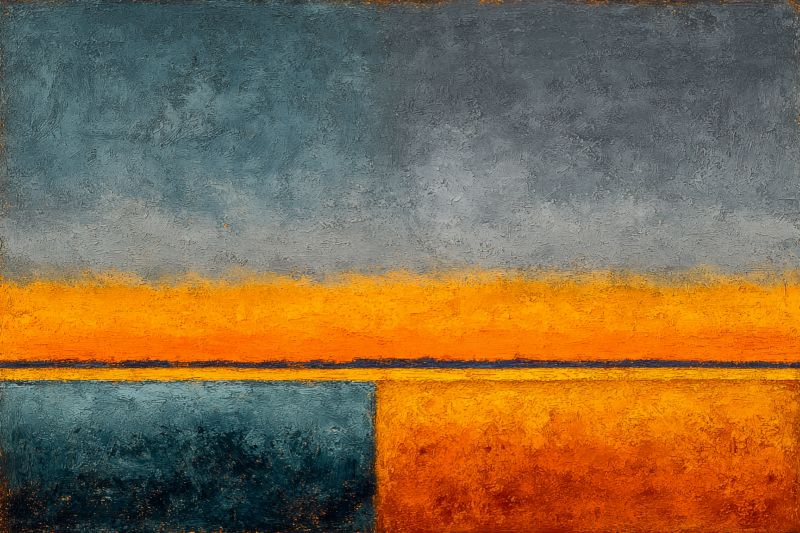
Twenty-first-century burnout is not about working too hard. It is about a society that has turned every person into a project, every hour into a performance review, and every rest into a moral failure. These thinkers name what that does to a life.
I
“Today, everyone is an auto-exploiting labourer in his or her own enterprise. People are now master and slave in one. Even class struggle has transformed into an inner struggle against oneself.”
Byung-Chul Han · The Burnout Society, 2015
Han’s diagnosis is precise and terrifying. The old oppression came from outside: a boss, a system, a visible enemy. The new oppression has no face because it is yours. You drive yourself. You punish yourself. You call it ambition.
II
“The violence of positivity does not deprive, it saturates; it does not exclude, it exhausts.”
Byung-Chul Han · The Burnout Society, 2015
This is a different kind of violence. No one is keeping you down. Everything is open, possible, available. And that openness is exactly what crushes you. The exhaustion comes not from being denied but from never being allowed to stop.
III
“Burnout isn’t a personal problem. It’s a societal one, and it will not be cured by productivity apps, or a bullet journal, or face mask skin treatments, or overnight oats.”
Anne Helen Petersen · Can’t Even, 2020
Petersen cuts through the wellness-industrial complex with a single sentence. The solutions the market offers for burnout are themselves products of the system that created it. You cannot buy your way out of exhaustion that was sold to you in the first place.
IV
“Millennials became the first generation to fully conceptualize themselves as walking college resumes.”
Anne Helen Petersen · Can’t Even, 2020
When you begin to see yourself as a document to be optimized, you lose the ability to distinguish between who you are and what you produce. The resume eats the person. The performance review replaces the inner life.
V
“You were not just born to center your entire existence on work and labor. You were born to heal, to grow, to be of service to yourself and community, to practice, to experiment, to create, to have space, to dream, and to connect.”
Tricia Hersey · Rest Is Resistance, 2022
Hersey does not argue against work. She argues against the total capture of a human life by work. The list she offers is not a productivity framework. It is a remembrance of what a life is supposed to contain.
VI
“The complaint of the depressive individual, ‘Nothing is possible,’ can only occur in a society that thinks, ‘Nothing is impossible.’”
Byung-Chul Han · The Burnout Society, 2015
This is burnout’s deepest paradox. Unlimited possibility creates unlimited failure. When everything is open to you, the inability to seize it all becomes a personal indictment rather than a structural condition.
VII
“Grind culture has made us all human machines, willing and ready to donate our lives to a capitalist system that thrives by placing profits over people.”
Tricia Hersey · Rest Is Resistance, 2022
Hersey names it plainly: the grind is not a personal choice, it is a donation. And what you donate is not just time but life itself. The system does not ask for your hours. It asks for your body, your sleep, your dreams.
VIII
“Productivity is a trap. Becoming more efficient just makes you more rushed, and trying to clear the decks simply makes them fill up again faster.”
Oliver Burkeman · Four Thousand Weeks, 2021
Burkeman exposes the treadmill hidden inside every productivity hack. You clear the inbox. The inbox refills. You finish the list. A new list appears. The system does not reward completion. It rewards acceleration.
IX
“We told ourselves we could have a massive expansion in the amount of information we are exposed to, and the speed at which it hits us, with no costs. This is a delusion: it becomes exhausting.”
Johann Hari · Stolen Focus, 2022
The cost was always there. We just agreed not to name it. Speed, volume, constant access: these were marketed as progress. But progress without pause is just another word for depletion.
X
“The Laziness Lie has three main tenets: Your worth is your productivity. You cannot trust your own feelings and limits. There is always more you could be doing.”
Devon Price · Laziness Does Not Exist, 2021
Three sentences. Three invisible rules that most people follow without ever hearing them stated aloud. Price names the operating system that runs beneath the burnout: you are never enough, and stopping is proof of it.
XI
“Depression is the sickness of a society that suffers from excessive positivity. It reflects a humanity waging war on itself.”
Byung-Chul Han · The Burnout Society, 2015
Han refuses to let depression remain a private diagnosis. It is a social symptom. The war is collective, even if the wounds are felt alone. Every exhausted individual is a casualty of a culture that mistook relentless positivity for health.
XII
“The rhetoric of ‘Do what you love, and you’ll never work another day in your life’ is a burnout trap. By cloaking the labor in the language of passion, we’re prevented from thinking of what we do as what it is: a job, not the entirety of our lives.”
Anne Helen Petersen · Can’t Even, 2020
The cruelest trick of modern work culture is making exploitation feel like self-expression. When your job becomes your identity, complaining about conditions feels like complaining about yourself.
XIII
“Grind culture is violence and violence creates trauma. We have been traumatized deeply.”
Tricia Hersey · Rest Is Resistance, 2022
Most people do not think of their work schedule as a form of violence. Hersey insists they should. The language is deliberate. What chronic overwork does to the body and spirit is not inconvenience. It is damage.
XIV
“The world is bursting with wonder, and yet it’s the rare productivity guru who seems to have considered the possibility that the ultimate point of all our frenetic doing might be to experience more of that wonder.”
Oliver Burkeman · Four Thousand Weeks, 2021
Burkeman asks the question that productivity culture cannot answer: what is all this efficiency for? If the engine runs perfectly but the passengers never arrive anywhere worth being, then the engine is not a solution. It is a distraction.
XV
“She believed she had uncovered a key truth about focus: to pay attention in normal ways, you need to feel safe.”
Johann Hari · Stolen Focus, 2022
Safety and attention are connected at the root. A nervous system in survival mode cannot concentrate, reflect, or rest. Burnout is not a failure of discipline. It is a failure of safety.
XVI
“In this society of compulsion, everyone carries a work camp inside. This labor camp is defined by the fact that one is simultaneously prisoner and guard, victim and perpetrator. One exploits oneself.”
Byung-Chul Han · The Burnout Society, 2015
The metaphor is extreme. Han means it to be. The internal work camp has no walls, no watchtower, no schedule posted on the door. It does not need them. You enforce the schedule yourself. You report yourself for resting.
XVII
“We live in a world where hard work is rewarded and having needs and limitations is seen as a source of shame.”
Devon Price · Laziness Does Not Exist, 2021
The shame is the mechanism. Without it, the system cannot run. If people could rest without guilt, need without apology, and stop without self-punishment, the entire architecture of overwork would collapse overnight.
XVIII
“Release the shame you feel when resting. It does not belong to you.”
Tricia Hersey · Rest Is Resistance, 2022
Seven words of liberation in the middle of a manifesto. The shame was placed in you. It was trained into your hands, your schedule, your sleep. It does not belong to you. It belongs to the system that profits from your exhaustion.
XIX
“Think not just about how to reduce your own burnout, but how your own actions are sparking and fanning burnout in others.”
Anne Helen Petersen · Can’t Even, 2020
Burnout is contagious. The midnight email you send teaches someone else to send one. The weekend you work without complaining sets a standard someone else will be judged against. Recovery is not individual. It is collective.
XX
“People who are chronically exhausted can’t pay attention.”
Johann Hari · Stolen Focus, 2022
The simplest sentence in this collection. And perhaps the most important. Burnout does not just take your energy. It takes your attention. And without attention, there is no presence, no creativity, no love, no life that feels like yours.
Voices from the Past
The diagnosis is modern. The warning is not. Long before burnout had a name, these thinkers saw what happens when a life becomes a performance of effort.
“It is not that we have a short time to live, but that we waste a great deal of it. Life is long enough, and a sufficiently generous amount has been given to us for the highest achievements if it were all well invested.”
Seneca · On the Shortness of Life, 49 AD
Seneca saw it two thousand years ago: the problem is not insufficient time. It is the compulsive misuse of the time we have. We pour it into busyness and then complain that the vessel is empty.
“All of humanity’s problems stem from man’s inability to sit quietly in a room alone.”
Blaise Pascal · Pensees, 1670
Pascal’s line has become famous enough to feel like decoration. But sit with it and it bites. The inability to be still is not a modern inconvenience. It is, Pascal insists, the root structure beneath nearly every form of human suffering.
“Nature does not hurry, yet everything is accomplished.”
Lao Tzu · Tao Te Ching, c. 4th century BC
The oldest rebuttal to hustle culture ever written. There is a pace at which things grow, heal, and complete themselves, and that pace is almost never the one the market demands.
“It is not death that a man should fear, but he should fear never beginning to live.”
Marcus Aurelius · Meditations, c. 170 AD
Marcus Aurelius names burnout’s deepest cost: not that you die tired, but that you never live awake. The exhausted person is not failing at work. They are failing at life, not through laziness but through the total absence of margin.
“The mass of men lead lives of quiet desperation. What is called resignation is confirmed desperation.”
Henry David Thoreau · Walden, 1854
Thoreau’s line belongs on every office wall that currently displays a motivational poster. The quiet desperation he describes is not dramatic. It is the background noise of a life spent meeting obligations that were never truly chosen.
About the Thinkers
Anne Helen Petersen is an American journalist and author whose 2019 BuzzFeed essay “How Millennials Became the Burnout Generation” became one of the platform’s most-read articles. Her book Can’t Even expands the argument into a generational critique of labor, debt, and digital pressure.
Blaise Pascal (1623-1662) was a French mathematician, physicist, and philosopher. His unfinished theological work Pensees, published posthumously, remains one of the sharpest investigations into restlessness, distraction, and the human refusal to sit with silence.
Byung-Chul Han is a South Korean-born, Berlin-based philosopher whose work examines how modern societies produce exhaustion, surveillance, and psychic crisis. His books include The Burnout Society, Psychopolitics, and The Scent of Time.
Devon Price is a social psychologist and professor at Loyola University Chicago. Their book Laziness Does Not Exist dismantles the cultural myth that human worth is determined by productive output.
Henry David Thoreau (1817-1862) was an American essayist, naturalist, and philosopher. His book Walden, written during two years of deliberate solitude at Walden Pond, remains a foundational text on simplicity, self-reliance, and resistance to the tyranny of busyness.
Johann Hari is a British journalist whose book Stolen Focus investigates the collapse of attention across twelve systemic causes, from chronic exhaustion and sleep deprivation to surveillance capitalism and the design of social media platforms.
Lao Tzu (c. 6th-4th century BC) is the legendary Chinese philosopher traditionally credited with the Tao Te Ching, a foundational text of Taoism. His teachings on effortless action, natural rhythm, and the wisdom of non-striving remain among the oldest antidotes to the culture of force.
Marcus Aurelius (121-180 AD) was a Roman emperor and Stoic philosopher. His private journal, known as Meditations, is a sustained practice in self-examination, discipline, and the refusal to waste the brief time one is given.
Oliver Burkeman is a British author and journalist whose book Four Thousand Weeks challenges productivity culture by confronting the radical finitude of human life: roughly four thousand weeks, if you are lucky.
Seneca (c. 4 BC-65 AD) was a Roman Stoic philosopher, statesman, and dramatist. His essay On the Shortness of Life argues that life is not brief by nature but made brief by the way most people squander it on trivial pursuits.
Tricia Hersey is an artist, theologian, and founder of The Nap Ministry. Her book Rest Is Resistance frames rest as a form of political resistance rooted in Black liberation theology, womanism, and the radical refusal of grind culture.
Sources
Anne Helen Petersen, Can’t Even: How Millennials Became the Burnout Generation (Mariner Books, 2020).
Blaise Pascal, Pensees, 1670.
Byung-Chul Han, The Burnout Society (Stanford University Press, 2015). Translated by Erik Butler.
Devon Price, Laziness Does Not Exist (Atria Books, 2021).
Henry David Thoreau, Walden, 1854.
Johann Hari, Stolen Focus: Why You Can’t Pay Attention and How to Think Deeply Again (Crown, 2022).
Lao Tzu, Tao Te Ching, c. 4th century BC.
Marcus Aurelius, Meditations, c. 170 AD.
Oliver Burkeman, Four Thousand Weeks: Time Management for Mortals (Farrar, Straus and Giroux, 2021).
Seneca, On the Shortness of Life, c. 49 AD.
Tricia Hersey, Rest Is Resistance: A Manifesto (Little, Brown Spark, 2022).
Curated by Nishant Mishra / The Nervous Age · Words for a world that won’t sit still.


Leave a comment